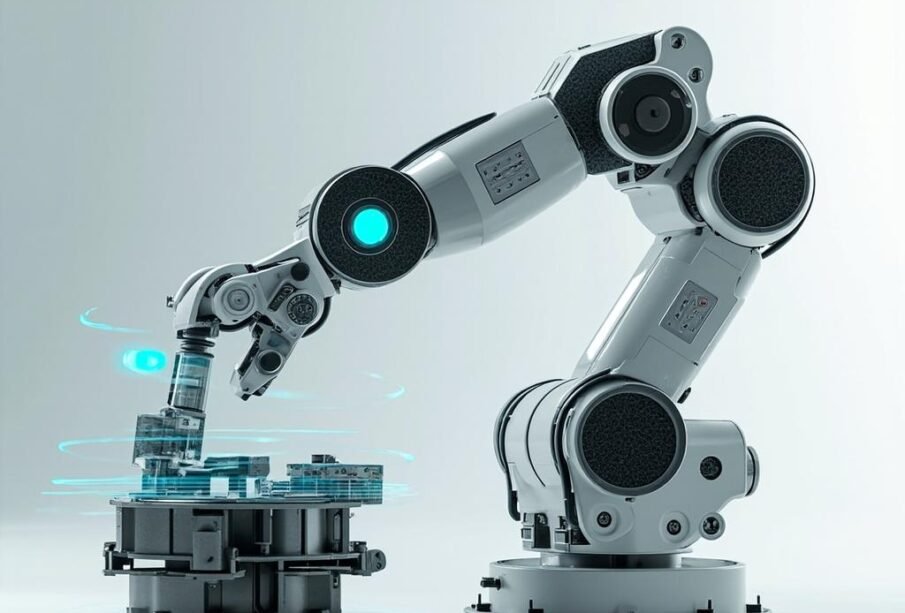
In the rapidly evolving landscape of industrial automation, force control in assembly robots has emerged as a critical technology that bridges the gap between rigid robotic precision and the nuanced requirements of real-world assembly tasks. As manufacturers increasingly seek solutions that combine speed, accuracy, and adaptability, understanding the fundamentals and applications of force-controlled robotics has become essential for engineers, plant managers, and automation specialists alike. This comprehensive guide explores the core principles, implementation strategies, and practical applications of force control systems in modern assembly robotics.
Understanding Force Control in Robotics
Force control is a robotic control methodology that enables machines to regulate and respond to physical contact forces during task execution. Unlike traditional position-based control, which relies solely on predetermined trajectories, force control allows robots to adapt their movements in real-time based on tactile feedback. This capability is particularly crucial in assembly operations where precise positioning meets variable environmental conditions.
The fundamental principle behind force control involves continuously monitoring the interaction forces between the robot’s end-effector and the workpiece or environment. When deviations from expected force profiles occur, the control system adjusts the robot’s trajectory, velocity, or impedance to maintain optimal contact conditions. This closed-loop feedback mechanism transforms robotic assembly from a rigid, predefined process into a flexible, adaptive operation capable of handling tolerances, misalignments, and variations inherent in real manufacturing environments.
Types of Force Control Strategies
Modern assembly robots employ several distinct force control methodologies, each suited to specific applications and performance requirements:
Impedance Control
Impedance control regulates the relationship between position deviation and contact force by establishing a desired mechanical impedance—essentially defining how “soft” or “stiff” the robot behaves upon contact. The control law establishes a dynamic relationship where the robot maintains equilibrium between applied forces and positional corrections, creating a natural, compliant interaction with the environment.
Admittance Control
In contrast, admittance control determines position or velocity outputs based on measured forces. When external forces are detected, the system calculates appropriate positional adjustments to accommodate the contact. This approach is particularly effective when the environment is stiff and the robot must yield gracefully to external influences.
Hybrid Position/Force Control
Hybrid position/force control represents the most sophisticated approach, simultaneously controlling both position along certain task axes and force along others. This strategy proves invaluable in assembly tasks where precise positioning is required in some directions while force regulation dominates in perpendicular axes—a common scenario in peg-in-hole insertions and similar operations.
Direct Force Control
Direct force control maintains specific force setpoints through continuous feedback, making it ideal for operations requiring constant, regulated contact pressure such as surface polishing, deburring, or material joining processes where consistent force application determines quality outcomes.
⚠️ Important Implementation Note: When transitioning from position control to force control strategies, always ensure proper safety interlocks are in place. Unexpected robot behavior during force control activation can pose hazards to equipment and personnel. Conduct thorough risk assessments and implement gradual force parameter increases during commissioning.
Essential Components and Sensors
The effectiveness of force control in assembly robots depends critically on the quality and configuration of sensing and processing components:
Force/Torque Sensors
Force/torque (F/T) sensors serve as the primary feedback elements in force-controlled systems. These devices, typically mounted between the robot wrist and end-effector, measure forces along three translational axes and torques around three rotational axes with high precision and bandwidth. Six-axis F/T sensors provide comprehensive contact information essential for complex assembly operations.
Tactile Sensors
Tactile sensor arrays complement F/T sensors by providing spatially distributed contact information across gripper surfaces. These sensors detect slippage, contact area, and pressure distribution—capabilities particularly valuable in part handling, insertion, and mating operations where local contact conditions significantly influence success.
Control Hardware and Software
Modern force control implementations require real-time processing capabilities capable of executing control algorithms at frequencies exceeding 1 kHz. Industrial robot controllers with dedicated force control modules, programmable safety controllers, and specialized force control software packages provide the computational foundation for responsive, stable force regulation.
Key Applications in Assembly Operations
Force control technology enables a wide range of assembly applications that would be difficult or impossible with traditional position-controlled robots. The following table summarizes the most significant applications:
| Application |
Force Control Benefit |
Typical Force Range |
| Peg-in-hole insertion |
Compensates for misalignment and tolerancing |
5-50 N |
| Screw driving |
Regulates torque and seating depth |
0.5-20 Nm |
| Press fitting |
Ensures consistent insertion force |
50-500 N |
| Surface polishing |
Maintains constant contact pressure |
2-30 N |
| Material handling |
Detects slip and ensures secure grip |
Variable |
| Quality testing |
Validates assembly integrity via force signatures |
Application-dependent |
Precision Assembly in Electronics Manufacturing
The electronics industry has embraced force-controlled assembly robots for delicate component placement operations. Connecting rod insertions, connector mating, and battery compartment assembly require precise force management to prevent damage while ensuring reliable connections. Force control enables these operations to proceed autonomously, reducing dependency on highly skilled operators and improving production consistency.
Automotive Component Assembly
In automotive manufacturing, force control proves essential for operations including gear assemblies, engine component installation, and wire harness routing. These applications demand both speed and precision, with force feedback enabling robots to navigate tight tolerances and variable part conditions while maintaining production throughput. The ability to detect and respond to resistance in real-time prevents part damage and ensures proper seating of critical components.
Medical Device Assembly
Medical device manufacturing presents unique challenges where force-controlled robotics provide critical advantages. Assembly of surgical instruments, prosthetic components, and diagnostic equipment requires meticulous force management to maintain product quality and regulatory compliance. Force control enables documentation of assembly forces, supporting traceability requirements while ensuring each unit meets exacting specifications.
Benefits of Implementing Force Control
Organizations implementing force control in assembly robots typically realize significant improvements across multiple operational dimensions:
- Reduced part damage: Force feedback prevents excessive insertion forces that damage components or mating surfaces
- Improved first-pass yield: Adaptive compliance compensates for manufacturing variations, increasing successful assembly rates
- Enhanced flexibility: Force-controlled robots handle product variations without mechanical retooling
- Reduced programming time: Force control enables intuitive teaching methods rather than extensive position programming
- Quality documentation: Force data provides traceability and enables statistical process control
- Worker safety improvement: Robots handle hazardous assembly operations, reducing ergonomic risks
Implementation Considerations and Best Practices
Successful deployment of force control in assembly robots requires careful attention to system integration, programming methodology, and operational parameters. The following considerations will help ensure project success:
Post Views: 38